Sodium hydroxide dissolved in water climbs to around 200°F in about ten seconds. That number is why most people never make cold process soap. It’s also the number that gets repeated without the part that matters, which is that it falls back under 100°F on its own in roughly twenty minutes while you stand there doing nothing to it.
Cold process has a reputation problem. Every beginner guide opens with a wall of warnings, a photo of goggles, and a paragraph about chemical burns, and by the time you reach the actual recipe you’ve decided to buy a melt and pour base instead. Fair enough. But the risk profile here is closer to deep frying than to anything in a laboratory, and nobody writes a thousand words of warnings before a doughnut recipe.
You still need to respect it. The difference between respecting something and being frightened of it is that one of them lets you start.
At a glance
- What’s genuinely hazardous: the lye solution, for about 30 minutes
- Hands-on time: 45 minutes for a first batch
- Where attention really matters: weighing, and adding lye to water
- Cost to try once: around $28, gear included
- Before you can use a bar: 6 weeks resting
- Most likely first-batch outcome: soap that works and looks uneven
What people are actually afraid of
Ask someone why they haven’t tried it and you’ll get one of three answers. They’re worried about burning themselves. They’re worried about fumes. Or they’ve read that a mistake in the maths produces a bar that damages your skin.
The first is real and manageable. The second is real for about sixty seconds. The third is mostly myth, and it’s the one worth killing first.
A lye-heavy bar — one where the numbers went wrong in the dangerous direction — doesn’t catch you out subtly. It fails loudly. It’s crumbly, it weeps, it feels slick and unpleasant the moment you wet it, and a strip of pH paper on the wet surface tells you inside two seconds. Bad soap announces itself. That’s the genuinely useful thing about it.
The lye doesn’t stay lye
Here’s the part the scary version leaves out. Saponification consumes the sodium hydroxide. It isn’t diluted, isn’t neutralised by something you add at the end, isn’t lurking in the bar waiting for you — it’s a reactant, used up, converted into soap and glycerin. By the time the loaf is firm enough to cut there is effectively none of it left.
Numbers help here. A rested bar sits around pH 9 to 10. Baking soda is 9. Your skin is about 5.5, so yes, soap is alkaline — every true soap is, including whatever is in your shower right now. That isn’t a cold process problem. That’s what soap is.
Superfatting is the other half of the answer, and it’s the part that should actually reassure you. You deliberately run about 5% more oil than the lye can convert, so the reaction runs out of sodium hydroxide before it runs out of oil. That margin swallows small weighing errors. Miss by a gram on a 500g batch and the superfat absorbs it without you ever noticing.
Only about five minutes of this needs real attention
A first batch runs roughly 45 minutes hands-on. Most of that is weighing oils, melting the coconut oil, washing up, and waiting for two containers to drift towards the same temperature. Pleasant, dull work.
Two moments carry the actual risk, and both are short.
Adding the lye to the water is the first. Thirty seconds, at arm’s length, goggles on, next to an open window or under a running extractor. The solution heats fast and gives off a sharp vapour for the first minute. Turn your head away, stir, then walk out of the room for five minutes if you’d rather. Nobody is marking you on it.
Weighing is the second, and people underestimate it because it doesn’t feel dangerous. It’s a scale and some numbers. But every serious formulation error starts here — a scale reading in 5g steps instead of 1g, a container tared wrong, a recipe halved in your head partway through. Weigh in grams. Write each number down as you go. Read them back once before anything gets mixed.
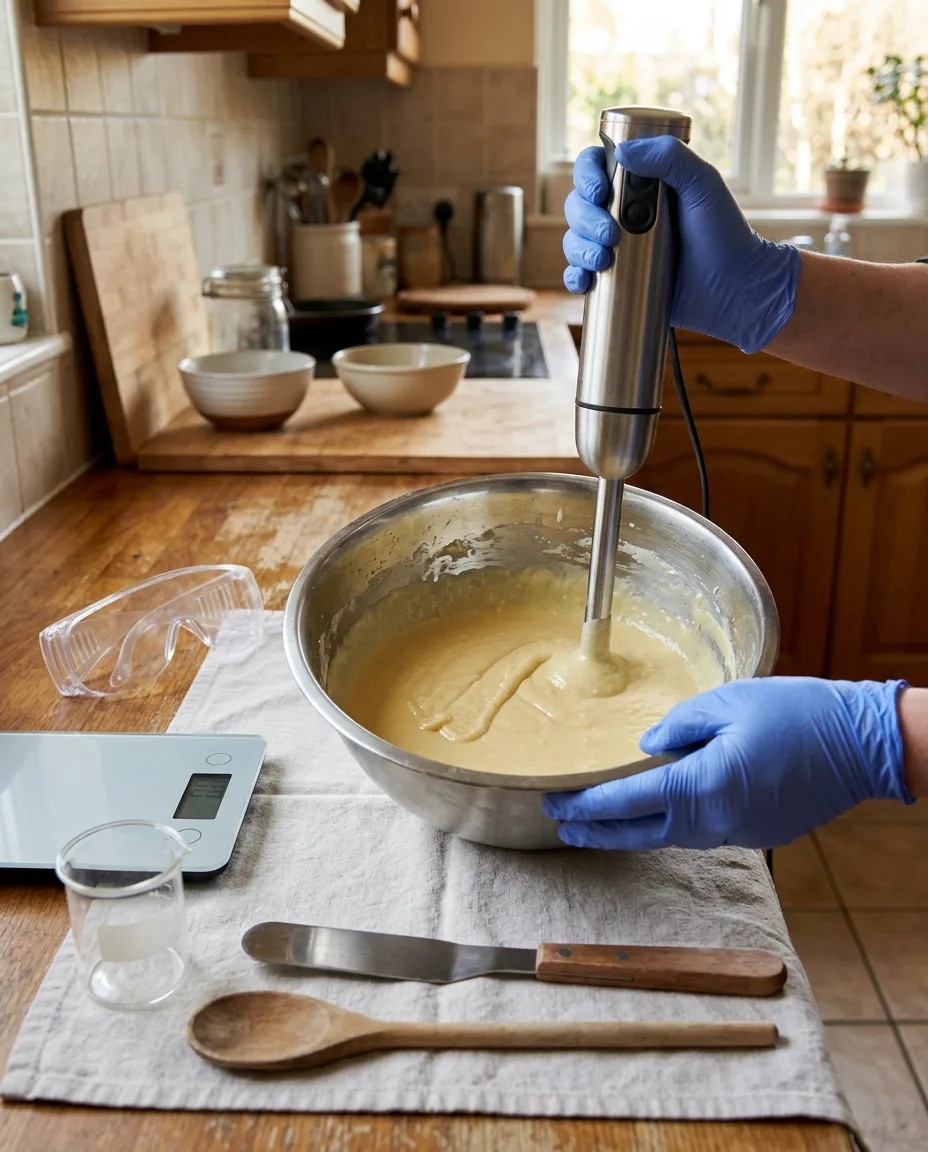
Everything after that is closer to making custard than chemistry. Lose concentration during the pour and the worst you get is an ugly bar.
Most of what goes wrong looks worse than it is
First batches rarely fail outright. They go strange. And strange, in cold process, is almost always cosmetic.
- A white chalky film across the top. Soda ash, from wet batter meeting air. Scrape it off or steam it. Cosmetic.
- A crack running down the middle. The loaf overheated in the mould. Cosmetic.
- A darker translucent ring through the centre. Partial gel, from heat moving unevenly through the loaf. Cosmetic.
- Batter that seizes into a solid lump in the bowl. Usually a fragrance oil accelerating the trace. Rebatch it.
- Oil separating out after the pour. Under-blended — you hit a false trace and stopped early. Rebatch it.
- Crumbly, weeping, slick to the touch. A real lye excess. Bin it.
Only the last one is a genuine failure, and it’s the rarest thing on that list. Soda ash is what you should actually expect the first time — a thin chalky film that wipes off with a damp cloth or steams away in ten seconds. It upsets people enormously and means nothing.
What it costs to find out
Worth naming the money, because “what if I waste it all” is the quieter reason people don’t start.
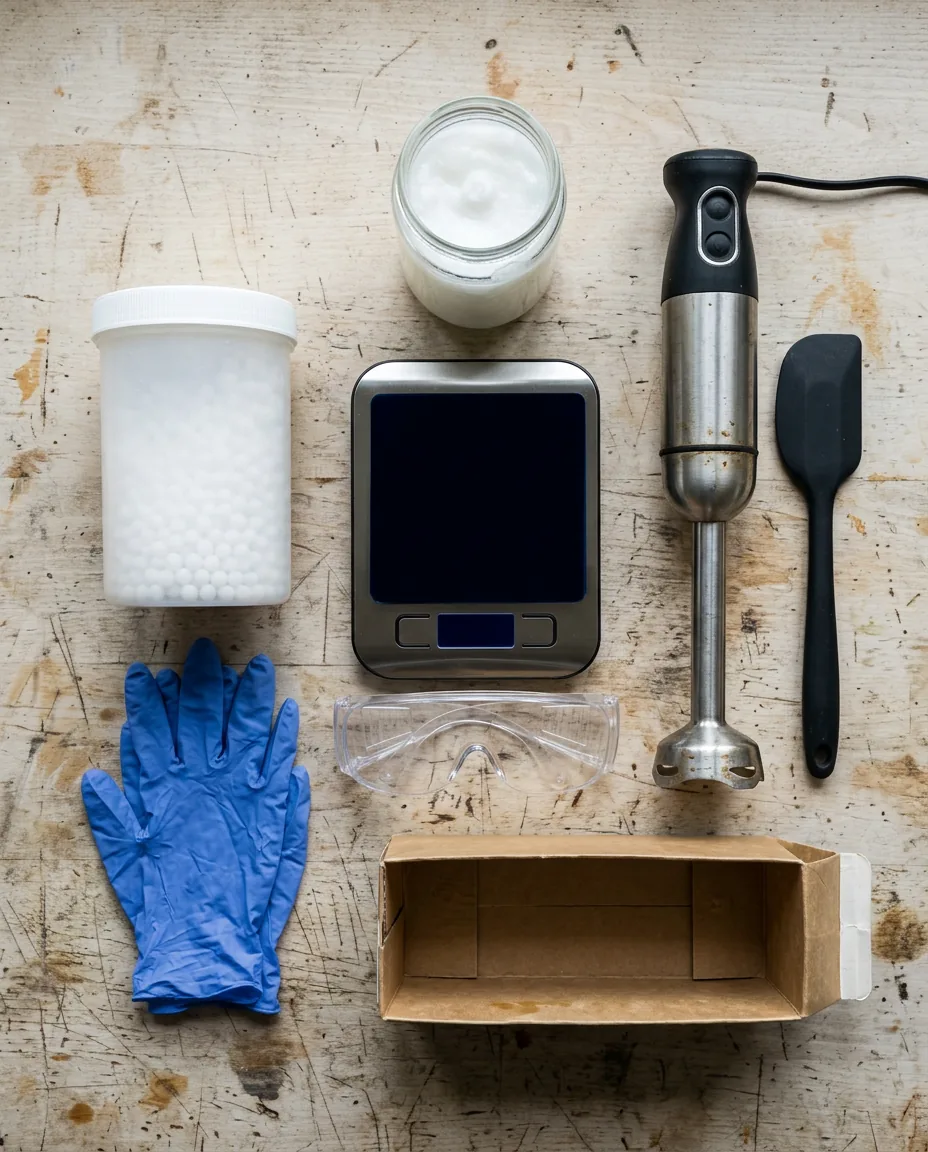
That buys enough lye and oil for four or five batches, not one. A silicone loaf mould adds about $12 if you’d rather not line a shoebox with baking paper. The scale is the one thing not to economise on — around $15 for one that reads to 1g, and you’ll still be using it in five years. If the first batch is a write-off you’re out roughly $6 of ingredients.
A first batch that’s hard to get wrong
Skip the fragrance. Skip the colour. Skip the swirl you saw on Pinterest.
Something around 70% olive oil to 30% coconut oil gives you a slow-moving batter that stays fluid for fifteen minutes or more, which is exactly what you want the first time. No rush. No accelerating fragrance. Room to be slow and careful and to stop and check things twice. The bar it makes is mild and hard enough to last, and it’s also plain and a bit boring to look at — which is the point. You’re not making a showpiece. You’re finding out whether the process bothers you.
Run the percentages through a lye calculator yourself rather than trusting a number off a blog post, this one included. Two minutes. It’s the habit that keeps you safe on every batch after this one.
Before you pour the lye
- Goggles on your face, not pushed up on your forehead
- Gloves on, sleeves down
- Window open or extractor running
- Children and pets out of the room, door shut
- Every weight written down and read back once
- Recipe run through a lye calculator today, not remembered from last time
- Lye going into the water, never water into the lye
Day two is when you cut it
Pour, cover, leave it alone. The loaf warms up by itself over the next few hours — that’s the reaction running, and it’s normal for the centre to reach 160°F or so and turn translucent before it cools back down. Some people insulate to encourage that. Some deliberately don’t. Neither choice ruins anything.
After 24 to 48 hours the loaf should feel firm, about like cold butter, and pull cleanly away from the mould. Cut it then. Leave it much longer and it hardens enough to crumble under the blade instead of slicing; go too early and it drags and smears.
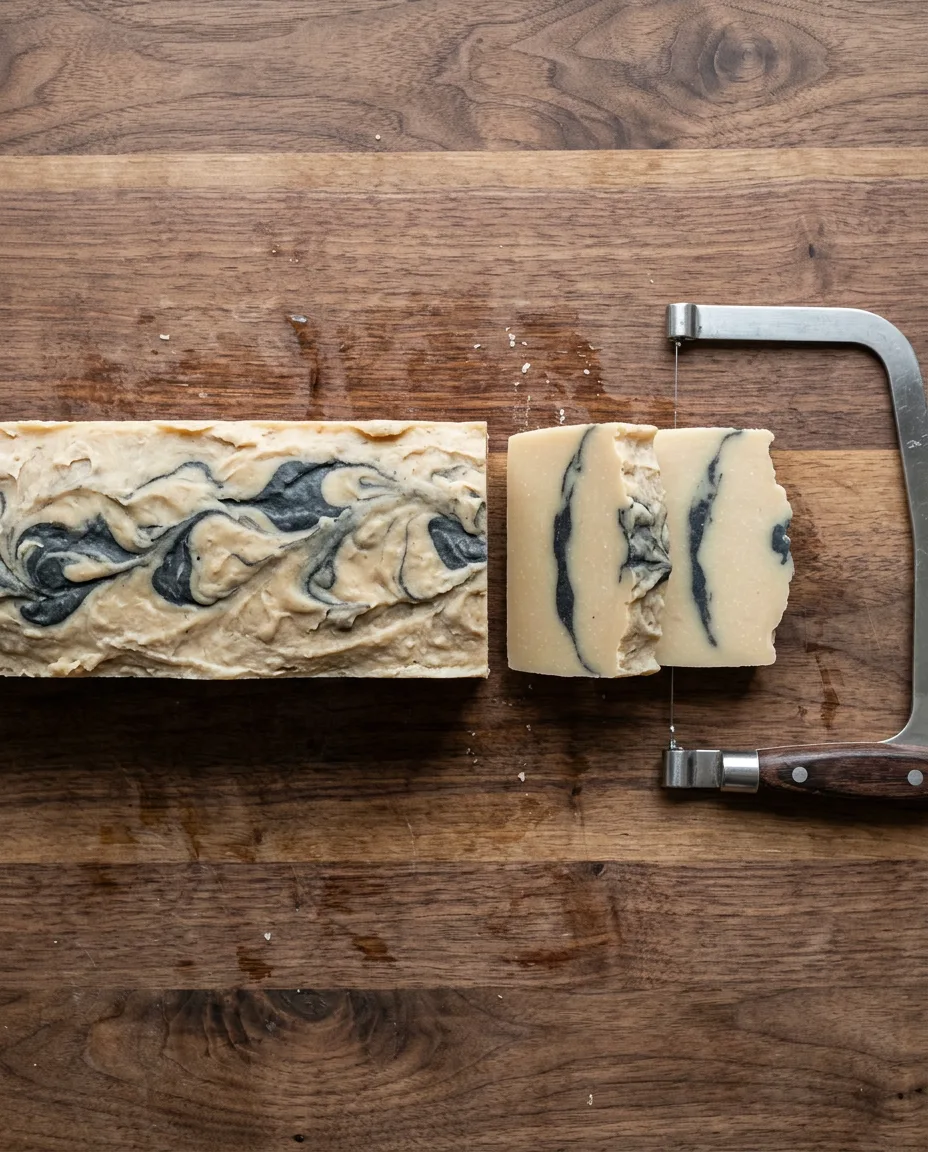
Keep the gloves on for the cut. Fresh bars are still mildly alkaline at that stage — not dangerous, but not something to handle bare-handed for ten minutes either.
Six weeks is the real barrier
Not the lye. The waiting.
Freshly cut bars are soft and full of water. Over six weeks that water leaves, the bar hardens, and the lather shifts from thin and disappointing to dense. A bar used at week one works, technically. It’ll also dissolve into mush in about four showers. The gap between a two-week bar and a six-week bar is wider than most beginners expect, and it comes down entirely to water loss.
Stand them on edge with air moving between them, out of direct sun. A wire rack does the job. So does a cardboard box with the flaps open. Turn them once a week if you remember, and don’t worry about it if you forget.
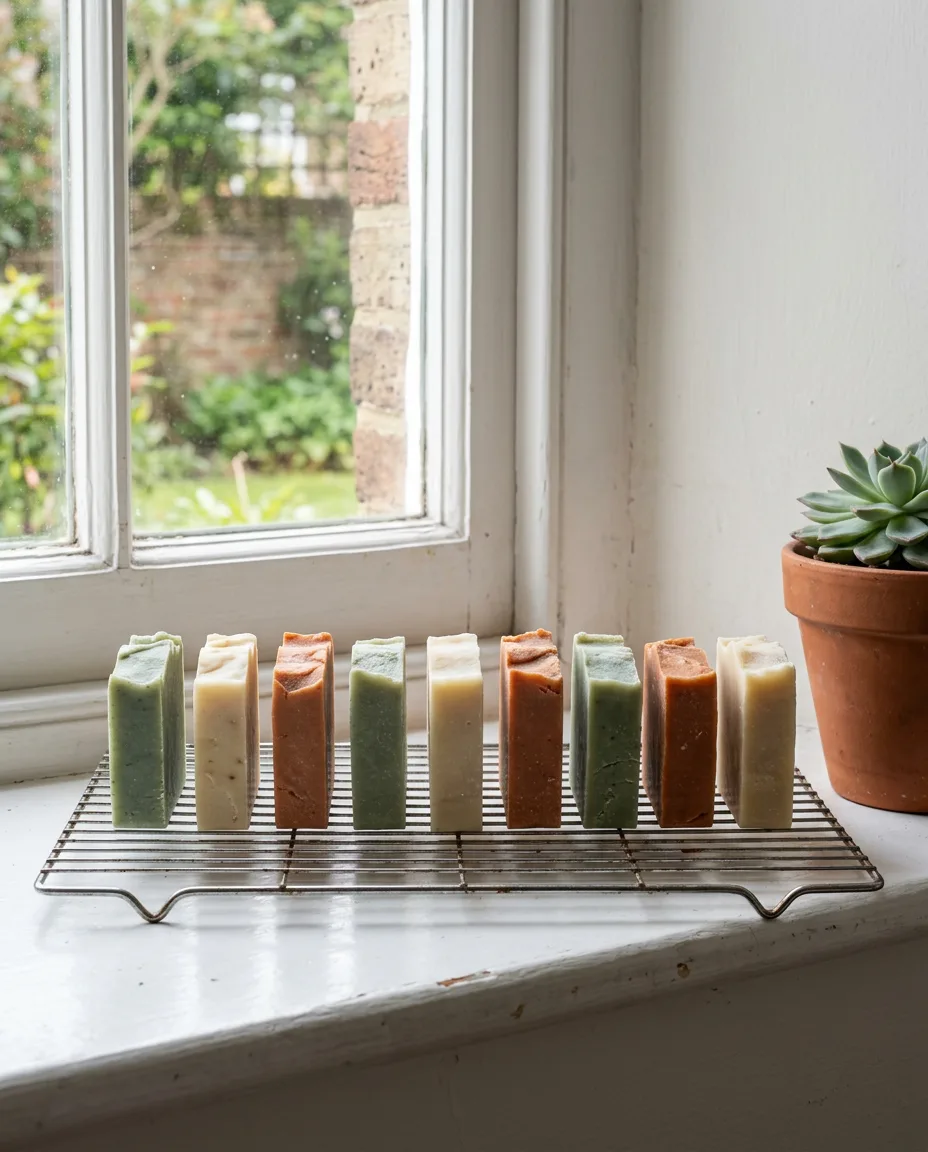
This is the part that actually stops people, and it isn’t fear. It’s impatience. You do the interesting 45 minutes, then nothing happens for a month and a half and the momentum dies quietly. The fix is unglamorous: start a second batch at week two, so something is always in the queue.
Where the caution actually belongs
Be more careful with the lye container between batches than during them. A jar of sodium hydroxide sitting in a kitchen cupboard, plain and unmarked, next to the flour, is a worse hazard than the thirty seconds you spend mixing it. Mark it clearly. Keep it dry, keep it high up, and store it well away from anything someone might reach for without looking.
Then go and make the batch. Two oils, 5% superfat, no fragrance, cheap mould. If it goes badly you’re out $6 and an afternoon, and inside 48 hours you’ll know which line on that list you landed on — five of which don’t matter.